
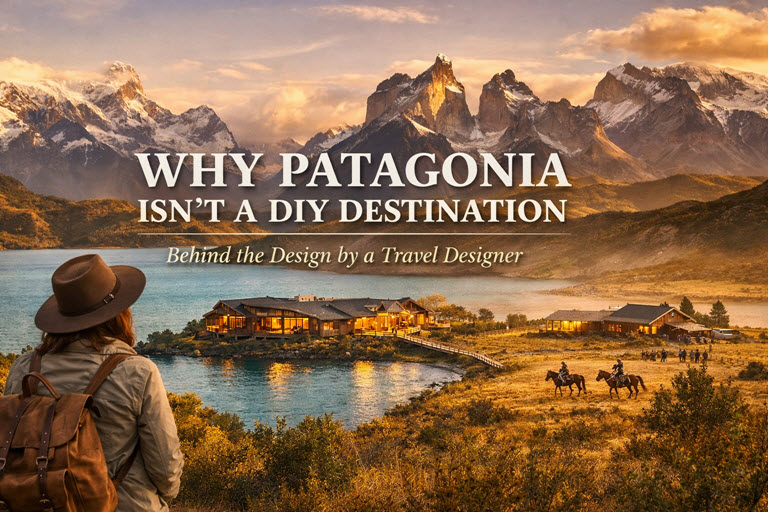
Luxury travel often looks effortless. A seamless flow through landscapes, thoughtful experiences, and smooth logistics that seem almost invisible.
In destinations like Patagonia, that effortlessness does not happen by chance. It is carefully designed through deep understanding of the region, trusted local partners, realistic pacing, and alignment between what a traveller wants and what the destination actually requires.
This is a story about that difference, and why Patagonia is not a place where guesswork works.
A Traveller, a Dream Trip, and a Misalignment
A traveller approached me to design a bespoke Patagonia and Iguazú Falls journey. She was travelling solo, in her senior years, and wanted a well paced itinerary that balanced nature, comfort, safety and required special needs.
I designed a thoughtful 13-day plan with private logistics and vetted local partners. In Bariloche, her three-night stay was structured to flow naturally:
• A scenic Llao Llao walk through forests and lake views
• A slower city and lakeside day to enjoy the atmosphere
• A private Seven Lakes Route experience with flexibility for scenic stops, photography, and pacing suited to a solo senior traveller
It was a balanced and realistic design that respected both the traveller’s energy and Patagonia’s scale.
But misalignment soon surfaced.
She compared the private Seven Lakes experience with a cheaper private tour she found online, assuming they were equivalent. What was not immediately visible was the fine print. The lower price applied only to a minimum number of participants, unvetted vendors (from Viator/Get Your Guide) and did not instruct in English. It offered none of the vetted vendors, instruct in a language she understood nor the flexibility or comfort that she was after.
From there, expectations diverged. She believed Patagonia could be navigated spontaneously, largely using public transport. From experience, I knew this would be challenging.
We eventually parted ways.
Months Later: The Reality of DIY Patagonia
Several months later, I came across her seeking advice on a public travel forum. This time, she was trying to plan Bariloche on her own.
What stood out immediately was that she had reused the exact structure of the itinerary I had designed:
• Three days in Bariloche
• One day for the Llao Llao walk
• One day to enjoy the city
• One day reserved for a major excursion
Without curated logistics, she was now struggling.
She could not decide between visiting the Arrayanes Forest or doing the Seven Lakes Route, as both required a full day. She wondered if Arrayanes Forest could be done just in the morning using public transport. She was surprised to learn that ferry schedules, travel times, and return routes made this impractical.
This moment is familiar to many travellers. It is when they realise Patagonia does not function like cities or well-connected destinations.
The Myth of the Half-Day Patagonia Excursion
One of the most common misunderstandings is the assumption that Patagonia allows for half-day sightseeing. That you can visit a scenic spot in the morning and still have the afternoon free.
Patagonia does not work that way.
Places like the Arrayanes Forest or the Seven Lakes Route may look close on a map, but in reality they involve long drives, fixed ferry schedules, extended walking routes, and return timings that cannot be adjusted easily. Even with private transport, these experiences usually take a full day. With public transport, flexibility is even more limited.
In Patagonia, nature sets the timetable.
When Premium Means Different Things to Different People
Another layer of complexity in destinations like Patagonia is how travellers define the word premium.
In cities, premium is often associated with visible features such as five-star hotels, elegant interiors, and familiar amenities. In remote wilderness regions, premium takes on a different meaning.
In places like Torres del Paine, premium often means architecturally sensitive lodges located within or near national parks, all-inclusive stays because there are no nearby alternatives, and carefully managed logistics due to distance, weather, and terrain. Comfort, warmth, and reliability matter more than spectacle.
Similarly, in Estancia Bonanza, premium is not a grand hotel environment. It is a privately hosted estancia experience, where horseback riding across open landscapes, personal hosting, and access to remote scenery are the luxury.
These were the types of accommodations and experiences designed into the proposal, not because they were extravagant, but because they were appropriate to the destination.
What sometimes emerges is a shift in how travellers interpret premium once they see how it functions on the ground. Some realise they are looking for a familiar city-hotel definition of luxury. Others realise they value simplicity over premium operations once they understand what those operations involve.
This is where misalignment becomes visible.
Premium travel is not about ballrooms or star ratings. It is about fit between the traveller, the destination, and the way the journey must work in reality.
Why Private and Group Tours Are Not Comparable
Many travellers compare experiences purely on price, without realising they are comparing different formats.
Group tours often involve long hours seated on buses, fixed routes, rigid timings, minimal scenic stops, and no adjustment for individual pace or energy.
Private curated experiences allow for flexible timing, scenic detours, photography stops, pacing suited to solo or senior travellers, and adjustments for weather or conditions.
Both have their place, but they are not interchangeable.
What Travel Design Really Solves
In destinations like Patagonia, travel design is not about booking more. It is about making things work.
Behind a seamless itinerary is careful consideration of distances and daylight, weather patterns, ferry and road schedules, energy levels, safety, and realistic combinations of experiences.
Without this structure, travellers often find themselves forced to choose between experiences, not because there is no time, but because logistics make it unavoidable.
A Quiet Lesson in Alignment
This story is not about right or wrong. It is about alignment.
Patagonia rewards travellers who respect its scale and rhythms. It is extraordinary precisely because it is vast, wild, and uncompromising.
When planned with intention, it becomes deeply rewarding. When approached casually, it can feel unexpectedly difficult.
Closing Reflection
Designing a bespoke journey is a partnership. It requires trust, realism, and an understanding that some destinations demand more structure than others.
Patagonia is one of them.
At Epic Travel Designer, my role is simple.
To design journeys that work in the real world, not just on a map.