
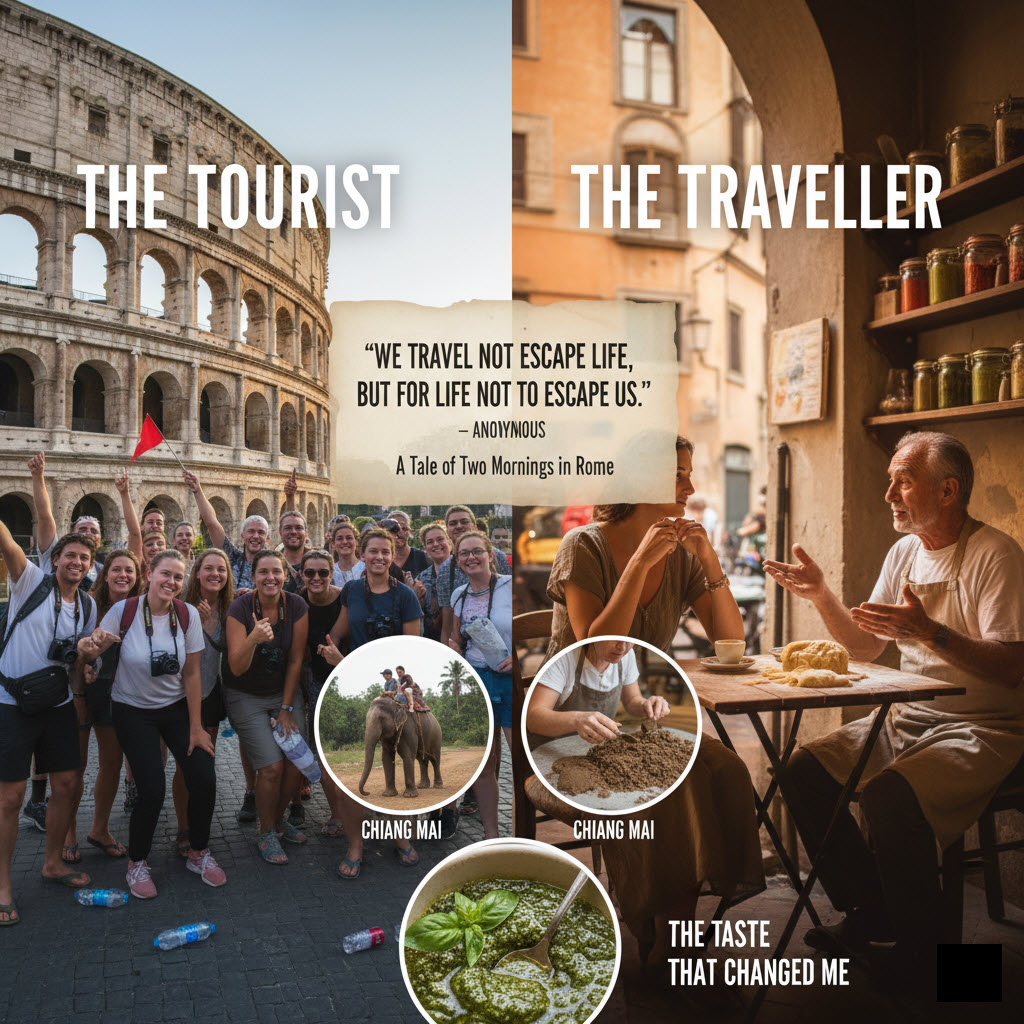
“We travel not to escape life, but for life not to escape us.” – Anonymous
A Tale of Two Mornings in Rome
It’s a bright Roman morning.
A bus hisses to a stop beside the Colosseum. The guide waves a little flag, and thirty people follow, cameras already clicking. “Quick photo, everyone. Ten minutes!”
They pose, smile, and hurry back on board. The Colosseum fades in the rearview mirror. Another box ticked. Another sight seen.
But across the street, a woman lingers in a side alley. She follows the scent of espresso and slips into a tiny café. The owner, a man with kind eyes and a dusting of flour on his apron, tells her about his grandmother who lived through the war and still rolls pasta by hand every Sunday.
She doesn’t see the Colosseum that morning. She feels Rome.
Same city.
Two different journeys.
One collects moments.
The other connects with them.
That’s the quiet difference between a tourist and a traveller.
The Tourist and the Traveller Within Us
We all start as tourists. Curious. Eager. Restless to see the world.
But somewhere along the way, the traveller in us begins to whisper.
It asks us to slow down, to listen, to look deeper.
A tourist asks, “What can I do here?”
A traveller wonders, “What can I learn here?”
At Epic Travel Designer, that’s the question we design every journey around.
Real travel doesn’t just show you places — it reveals parts of yourself you didn’t know were waiting.
A Lesson from the Elephants of Chiang Mai
In northern Thailand, nearly every traveller’s itinerary includes the same thing — see the elephants.
It sounds magical. Majestic animals. Lush jungles. Smiling photos.
But what most never see are the scars hidden beneath the paint, the weight those elephants carry, the endless circles they walk for human entertainment.
That’s why we do it differently.
When we bring our clients to Chiang Mai, we take them to one of the few sanctuaries that truly protect elephants — not perform with them. There are no rides. No shows. Only kindness.
You spend the morning learning what elephants eat, how they communicate, and how to bathe them gently in the river. The air is full of laughter and mud and sunlight. Then comes something you’ll never forget — discovering that elephant dung, once dried and cleaned, can be recycled into paper.
It’s the ultimate lesson in renewal — turning what’s discarded into something meaningful and sustainable.
By the end of the day, our travellers don’t just see elephants differently. They see themselves differently. And they carry that awareness home — in their choices, their compassion, their care for the world.
That’s what we believe travel should do. Not entertain. Transform.
The Taste That Changed Me
I used to joke that I could live my whole life without pasta or pizza.
Then Italy happened.
I spent a month there — surrounded by markets bursting with sun-warmed tomatoes, basil, olive oil, and locals who spoke about food as though it were a language of love. But at first, I resisted. Pasta felt heavy, predictable — until curiosity finally got the better of me.
One morning, I tried a spoonful of pesto on toast.
It was nothing like the supermarket version I knew. Fragrant. Earthy. Alive.
Something clicked that day. I started tasting everything differently. I tried pesto with walnuts, with sun-dried tomatoes, even with a squeeze of lemon. Soon, I was collecting jars of different flavours to bring home — little bottles of discovery.
Food started to teach me.
It taught me that simplicity can be profound. That ingredients can tell stories. That every destination leaves its taste on you if you let it.
These days, I find myself cooking differently — a little healthier, a little braver, a little more curious. Travel does that. It reshapes your palate, but also your perspective.
Sometimes, the transformation begins not in the grand sights, but in the smallest bite.
In the Quiet of Ine, Japan
On the other side of Asia lies Ine — a fishing village north of Kyoto where time slows to the rhythm of waves. Wooden funaya houses float gently on the water; fishermen call out greetings as they cast their nets.
When we stayed there, mornings began with tea on the dock, legs dangling above the sea. There were no crowds. No schedules. Just the soft hum of life continuing as it always had.
That’s when you realise: travel isn’t about motion. It’s about stillness.
It’s about hearing a place breathe — and letting it breathe something new into you.
Our Philosophy: Leave Nothing But Understanding
Every journey we design at Epic Travel Designer begins with one belief: travel should give more than it takes.
We encourage our clients to:
• Support local artisans over chain stores
• Stay in eco-conscious lodges that honour the land
• Seek knowledge over novelty
• Leave behind not souvenirs, but understanding
When you travel with intention, you return home changed — softer, wiser, fuller.
Final Reflection
There’s a saying we live by:
“The tourist sees what they came to see; the traveller sees what they came to find.”
A tourist rides an elephant.
A traveller learns how its dung becomes paper.
A tourist rushes past the Colosseum.
A traveller lingers over coffee with a stranger and learns about resilience.
A tourist eats to fill their stomach.
A traveller eats to understand the soul of a place — and sometimes, themselves.
That’s the journey we want for you — not just to see the world, but to feel it.
To travel lightly, love deeply, and let every experience shape who you become.
When you’re ready to travel differently, we’ll be here — to design the journey that transforms you.