
Introduction
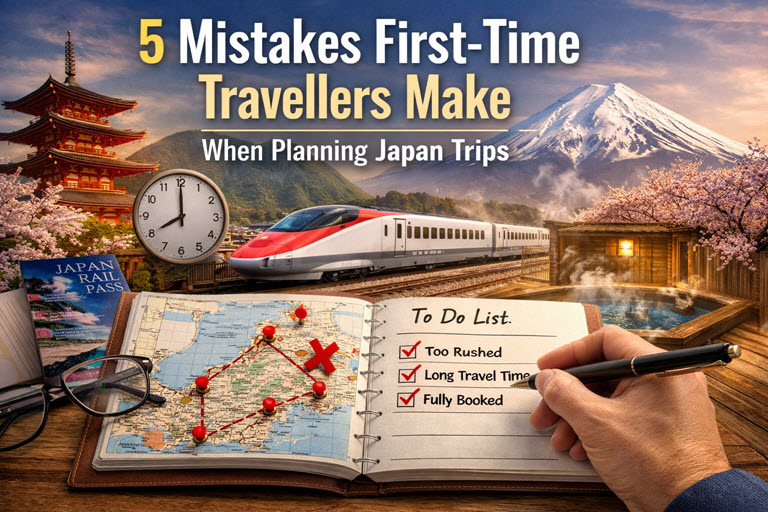
Most first-time trips to Japan do not fall apart because of bad decisions. They fall apart because the trip was never designed properly to begin with.
Japan looks easy on the surface. The trains are efficient, information is widely available, and many travellers feel confident planning it themselves. But once you start putting everything together, the gaps begin to show. Days feel rushed, routes do not make sense, and the trip becomes something you have to manage instead of enjoy.
These are the most common mistakes I see when travellers are planning a trip to Japan.
Mistake 1: Trying to See Too Much
Most first-time travellers approach Japan with the same mindset.
“If I am already there, I should cover as much as possible.”
So the itinerary starts expanding. Tokyo, Kyoto, Osaka, maybe Hiroshima, perhaps squeeze in Hakone or somewhere else along the way.
On paper, it feels productive. In reality, it creates a trip that is constantly in motion but never truly experienced.
What is often overlooked is that moving between destinations is not just about the train ride. It involves packing, checking out, navigating stations, managing luggage, and settling into a new place. Each transition takes more energy than expected, and when repeated over multiple days, it becomes exhausting.
Instead of experiencing Japan, you end up managing movement.
The irony is that by trying to see more, you actually experience less. The trip becomes a checklist rather than a journey.
A well-designed itinerary focuses on depth, not coverage. When you allow time for places to unfold, the experience becomes more meaningful and far more enjoyable.
Mistake 2: Underestimating Travel Time
Because Singapore is small and highly efficient, many travellers assume Japan works the same way.
In reality, Japan is much larger, and travelling from one destination to another can easily take hours. What looks straightforward on a map often becomes more involved once you factor in the full journey.
You need to account for packing, moving luggage, getting to the station, navigating large train stations, locating the correct platform, waiting time, and transfers. If you are driving or on a guided tour, traffic conditions can also affect your schedule.
Even after arriving, there is still the process of checking in before you can properly settle in and begin your day.
All these elements add up. A journey that appears short can take up a significant portion of the day.
When this is not factored in properly, the itinerary becomes unrealistic and the trip starts to feel rushed.
Mistake 3: Poor Route Planning
Most travellers begin by listing all the places they want to visit and then try to connect them.
This approach works in theory but often breaks down in practice.
Japan’s transport system is extensive, but without a strong understanding of how different routes, regions, and connections work together, it is easy to create itineraries that involve unnecessary backtracking or inefficient travel.
Adding one destination may seem minor, but if it disrupts the flow of the route, it can increase travel time significantly and affect the pacing of the entire trip.
Good route planning is not about linking places together. It is about sequencing them in a way that makes sense geographically, logistically, and experientially.
Without this, even a well-researched itinerary can feel disjointed.
Mistake 4: Not Booking Key Experiences Early
Japan rewards those who plan ahead, especially when it comes to accommodation and unique experiences.
In more remote areas, options can be very limited. There may only be one or two suitable ryokans available, and meals are often included because there are no nearby dining options.
Take Ine for example. The appeal lies in staying in a funaya, a traditional boathouse by the sea. However, there are only a handful of these accommodations, and they are quickly booked. Dining also needs to be arranged in advance with selected restaurants in the area.
In places like Aomori, some attractions are supported by only one nearby ryokan. If it is fully booked, the next available option could be an hour away, which results in unnecessary travel time and disruption.
Many travellers assume they can decide later or book closer to their travel date. By then, the best options are often no longer available, and the structure of the itinerary is compromised.
Mistake 5: Planning Without Understanding Travel Style
This is the mistake that underpins everything else.
Most travellers plan based on what they think they should see rather than how they actually want to travel.
Some prefer a slower, more immersive experience but end up with packed itineraries. Others want to cover more ground but underestimate how tiring constant movement can be. For families, the challenge becomes even more complex as different preferences need to be balanced.
Without clarity on travel style, the itinerary becomes a mismatch.
It may look good on paper, but during the trip, it does not feel right.
A Better Way to Plan Your Japan Journey
Most of these mistakes do not come from lack of effort. They come from trying to piece together a complex trip without seeing how everything connects.
A more effective approach is to work with a Japan travel planner and leverage their experience in designing these journeys.
If you are considering this approach, I have written a detailed guide on how to choose a Japan travel planner in Singapore, including what to look out for and how to avoid common pitfalls.
How to Choose a Japan Travel Planner in Singapore
Instead of focusing on individual bookings, the entire trip is structured from the ground up. The route, pacing, logistics, and experiences are aligned to your preferences so that everything flows naturally.
All you need to do is prepare for the trip and enjoy it.
More importantly, if something unexpected happens during the journey, you are not left to manage it alone. A Japan travel planner understands your itinerary and can step in to support you when needed.
If you are planning your first trip and want to avoid these common mistakes, you can partner with a Japan travel planner and leverage on their expertise for a smoother journey.
About The Author
Best Teo is the Chief Travel Designer of Epic Travel Designer.
She specialises in designing complex, well-paced journeys across Japan, combining deep destination knowledge with strong logistics planning. Her focus is on creating trips that flow naturally, allowing travellers to experience Japan in a way that feels seamless, balanced, and complete.