
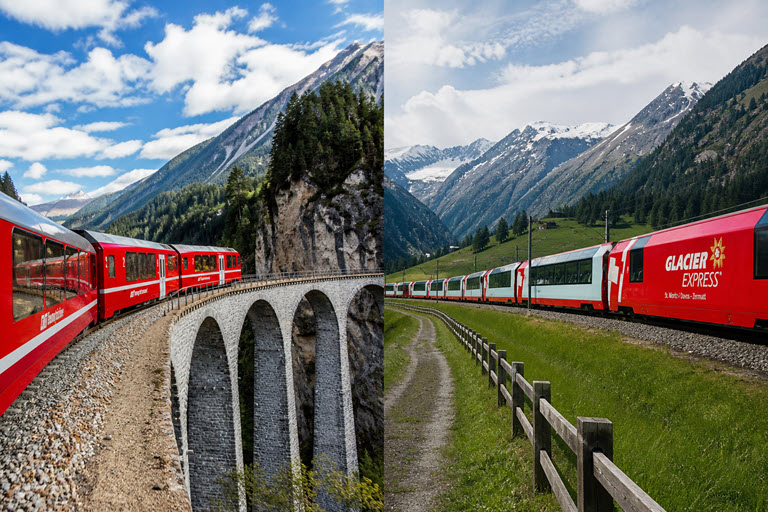
Introduction
The question sounds simple at first. Should you take the Bernina Express or the Glacier Express?
Most travellers ask this as if they are choosing between two attractions. In proper Switzerland planning, that is rarely the right way to look at it. The Bernina Express and Glacier Express are not just scenic trains. They sit in different parts of the country, connect different regions, and create very different consequences for your itinerary.
If you’re planning a complete rail holiday rather than choosing just one scenic train, my guide on planning a luxury Switzerland train tour explains how these iconic railways fit into the bigger journey.
The Bernina Express is shorter, more dramatic in contrast, and especially useful when your journey includes the Engadin, St. Moritz, or onward travel into Italy. The Glacier Express is longer, slower, and works beautifully when you want to connect Zermatt with St. Moritz without flying across the map by standard rail.
As a Switzerland Trip Planner, I usually start with a more practical question. Where are you coming from, where are you going next, and how much energy do you want to spend sitting on a train?
A scenic train can be a highlight. It can also become the part of the trip that quietly exhausts everyone if it is forced into the wrong day. The best choice is not always the more famous one. It is the one that supports the flow of the whole journey.
The Bernina Express Is Shorter, But Not Necessarily Simpler
The Bernina Express is one of Switzerland’s most recognised rail journeys, and for good reason. The route between Chur, St. Moritz, and Tirano crosses the Albula and Bernina lines, with viaducts, spirals, glaciers, high mountain lakes, and a remarkable descent into northern Italy.
From Chur to Tirano, the panoramic journey takes around four hours. From St. Moritz or Pontresina to Tirano, it is shorter, but still extremely rewarding. This is the section many travellers remember most clearly because the landscape changes quickly. Alpine lakes, snowfields, stone villages, and then suddenly a warmer Italian atmosphere.
The common mistake is treating it as a same-day round trip.
Some clients initially suggest taking the Bernina Express from St. Moritz to Tirano and returning the same day, giving themselves around one hour in Tirano before boarding back. On paper, it works. In real life, it can feel like eight hours of sitting for a short pause in the middle.
For rail enthusiasts, that may be perfectly acceptable. For families, older travellers, or clients who value comfort over completion, I would usually adjust it. Stay in St. Moritz for two nights, take the Bernina route one way, enjoy Tirano properly, or return by a different rhythm if the itinerary allows.
The Bernina Express rewards travellers who give the Engadin some space. If you rush into St. Moritz at night, take the train the next morning, and leave immediately after, you technically experienced the route but missed the region that gives it context.
During busy periods, availability can create another layer of complexity. Read how I secured 11 first-class Bernina Express seats when public availability appeared sold out.
The Glacier Express Is About Slow Travel, Not Efficiency
The Glacier Express connects Zermatt and St. Moritz in around eight hours. It is famously slow, and that is part of its identity. The train crosses a wide alpine spine of Switzerland, passing through valleys, high passes, gorges, and mountain towns that would otherwise be awkward to combine elegantly.
The full route is long. That needs to be understood before it is booked.
For some travellers, eight hours on a train sounds indulgent. For others, it becomes tiring after the fourth hour, no matter how beautiful the view is. This is where traveller temperament matters. A couple celebrating a milestone anniversary may enjoy settling into the rhythm with lunch, wine, and changing scenery. A family with young children may find the same journey too passive.
For honeymooners, the question is not only which train has the better scenery. It is also which journey creates the right pace and experience for the couple. Read my guide to planning a Switzerland honeymoon for the wider design considerations.
For ultimate luxury seekers, Excellence Class changes the experience considerably. It has only 20 seats in the carriage, with a guaranteed window seat, refined service, a multi-course meal, and wine pairings. It is not simply about a better seat. It turns the day into a hosted rail experience, with space, privacy, and a slower sense of occasion.
Still, luxury does not remove the basic fact of time.
The most beautiful stretch, in my view, is from Andermatt towards the Engadin and St. Moritz. This section brings some of the strongest mountain drama and variety. If a client wants the essence of the Glacier Express but does not want the full eight-hour journey, I would consider breaking the route across multiple days or using selected sections more intentionally.
The Glacier Express works best when it connects places you already want to visit. It becomes less convincing when travellers detour across Switzerland simply to say they have taken it.
Choosing Between Them Depends on Your Geography
The Bernina Express and Glacier Express are often compared as if they occupy the same role. They do not.
The Glacier Express is a cross-country alpine connector. It makes sense when your Switzerland itinerary includes Zermatt and St. Moritz. You begin beneath the Matterhorn and end in the Engadin, which is one of the most elegant geographic transitions in the country. It is long, but it has purpose.
The Bernina Express is more concentrated. It belongs naturally to the Engadin and the southern edge of Switzerland. If you are already staying in St. Moritz, Pontresina, or nearby, it becomes easy to include without distorting the trip. It also works well if you are continuing to Lake Como, Milan, or other parts of northern Italy.
Problems begin when the train is added without respect for distance.
For example, a traveller staying in Lucerne who wants to “do the Bernina Express” as a day trip may not realise how much positioning is involved. Getting to Chur or St. Moritz, taking the panoramic route, and then returning can become a punishing day. It is not impossible, but possible is not the same as well designed.
Likewise, a Glacier Express day inserted between unrelated hotel stays can create luggage complications and long transfer chains before and after the train.
When I design Switzerland journeys, I look at the map before I look at the train names. Zermatt, Andermatt, St. Moritz, Chur, Lucerne, and Tirano each sit in very specific relationships to one another. A beautiful train becomes far more enjoyable when the geography is respected.
How I Would Combine Both Without Overloading the Trip
If your aim is to experience Switzerland’s great scenic trains, I would not necessarily choose only one. The Bernina Express and Glacier Express can work beautifully together when they are arranged as a natural progression rather than a checklist.
A strong version might begin in Zermatt, with two or three nights to settle at altitude and enjoy the Matterhorn area properly. From there, take the Glacier Express towards St. Moritz. If the full eight-hour journey suits your style, consider Excellence Class and make the train day a centrepiece. If not, break the route, perhaps with an overnight in Andermatt or another carefully chosen stop.
After arriving in St. Moritz, do not rush straight onto the next train.
The Engadin deserves breathing room. St. Moritz itself has energy, polished hotels, lakeside walks, and access to nearby villages such as Pontresina and Sils Maria. Two nights is the minimum I would consider. Three is better if you want to include mountain excursions or a slower day after the Glacier Express.
Then the Bernina Express can continue the story from St. Moritz or Pontresina to Tirano. This feels logical because you are moving south from the high Engadin into Italy, not making an artificial loop. Depending on the wider itinerary, you can return to Switzerland, continue to Milan, or connect towards Lake Como.
This style of planning also reduces fatigue. Instead of stacking scenic trains back to back, the journey alternates between movement and rest. That is the detail many itineraries miss.
Scenery is not only about what you see through glass. It is also about whether you arrive with enough energy to enjoy where you are.
See how this thinking can be applied in a 14-day Grand Train Tour of Switzerland.
Conclusion
There is no universal winner between the Bernina Express and Glacier Express.
Choose the Bernina Express if you want a shorter, highly scenic route with strong contrast, especially if your itinerary already includes St. Moritz, Pontresina, Chur, Tirano, or northern Italy. It is vivid, efficient, and memorable, but it should not be squeezed into an exhausting same-day exercise unless you genuinely enjoy long rail days.
Choose the Glacier Express if you want a slower alpine crossing from Zermatt to St. Moritz, and if the journey itself is part of the purpose. It is best suited to travellers who appreciate pace, service, and a full day of unfolding scenery. Excellence Class can make it especially appealing for clients who want comfort and privacy.
If time allows, the most satisfying answer may be both. Start in Zermatt, travel across to St. Moritz on the Glacier Express, pause in the Engadin, then continue on the Bernina Express towards Tirano. That is not just collecting famous train names. It is using Switzerland’s rail geography properly.
A well-designed Switzerland journey is not measured by how many scenic trains are included. It is measured by how naturally each one belongs.
If you are deciding between the Bernina Express and Glacier Express, explore how a Switzerland travel planner shapes the route around your pace, hotels, luggage flow and onward plans.
The right answer usually becomes clear once the whole journey is designed properly.
For a complete journey designed around the right scenic trains, hotel bases and travel rhythm, explore my luxury Switzerland private tours from Singapore.
About the Author
Best Teo is the Chief Travel Designer of Epic Travel Designer, a Singapore-based boutique travel company specialising in customised private journeys.
She is a Certified Switzerland Travel Expert and Swiss Travel System Excellence Expert, with firsthand experience travelling across Switzerland by rail, scenic trains, lake cruises and mountain transport.
Best designs customised Switzerland itineraries for couples, families and multi-generational travellers, with careful attention to routing, pacing, weather flexibility, hotel bases and travel logistics.