
Every Journey I Design Begins With People, Not Places
One of the biggest misconceptions about planning a Switzerland holiday is believing the destination comes first.
It doesn’t.
Every journey I design begins with people, not places.
This philosophy forms the foundation of my Switzerland Travel Planner, where I share how thoughtful planning creates a more enjoyable holiday.
Before deciding whether someone should stay in Lauterbrunnen, Wengen or Mürren, I first want to understand how they like to travel.
Can they comfortably walk two or three kilometres?
Do they enjoy changing hotels every few days, or would they rather unpack once and explore from a single base?
Have they recently recovered from an injury?
Would they feel more confident if someone helped them through the first couple of days before continuing independently?
One question I ask quite often is whether they actually enjoy changing hotels every two or three nights.
Many mature travellers tell me they don’t.
It isn’t because they can’t. Their priorities have simply changed.
Every hotel move involves far more than packing a suitcase. It means checking out, travelling to the next destination, checking in again, unpacking, familiarising yourself with a new room, learning a different hotel layout and settling into completely new surroundings. These may seem like small adjustments, but after a while they begin to consume energy that could have been spent simply enjoying the holiday.
The answers to these questions influence almost every decision that follows.
Recently, I worked with a couple in their sixties who perfectly illustrate this.
Both were professionals who had travelled extensively and knew exactly what they wanted from Switzerland. They loved nature, enjoyed gentle walks and wanted to experience the country’s famous scenic trains. At the same time, one had previously fractured an arm, while the other had suffered a back injury. They had no interest in dragging luggage through train stations or changing hotels every other day.
Could they have travelled independently?
Absolutely.
But the journey needed to be designed differently.
Instead of asking, “How many places can we fit into twelve days?”, we asked a far more important question.
“How can we make twelve days feel effortless?”
That single change in thinking influenced every part of the itinerary.
Travel Designer Insight
Great journeys don’t begin with destinations. They begin with understanding the people who will experience them.
Good Travel Design Removes Uncertainty
When people hear the words “private tour”, many immediately think about travelling everywhere with a chauffeur.
That certainly works for some destinations, but Switzerland is different.
Part of Switzerland’s charm lies in travelling through the country itself. Sitting on panoramic trains as vineyards become alpine valleys. Taking a boat across a crystal-clear lake before boarding a historic cogwheel railway into the mountains. Watching the scenery change through the train window instead of through the windscreen of a car.
I never want my clients to miss those experiences.
At the same time, I also recognise that arriving in Zurich after a long overnight flight is probably not the best time to ask someone to navigate multiple train transfers with luggage.
For many mature travellers, I often recommend beginning the journey differently.
A private airport transfer allows them to settle into Switzerland without immediately worrying about train platforms, tickets or finding their hotel. Instead, they can simply enjoy the drive, learn a little about the country and ease into the rhythm of the holiday.
During the first couple of days, I may also recommend a private guide in places such as Zurich or Lucerne.
Not because my clients are incapable of travelling independently.
Quite the opposite.
The guide becomes a bridge between arriving in a new country and confidently exploring it on their own.
By experiencing Switzerland’s transport system alongside someone familiar with it, many travellers quickly realise it isn’t nearly as complicated as they first imagined.
That confidence grows naturally over the course of the trip.
Eventually, they are travelling independently through the mountains, not because they have to, but because they genuinely enjoy the freedom.
For me, that is what good travel design should achieve.
It should never take independence away from the traveller.
It should simply remove the uncertainty that prevents them from enjoying it.
Travel Designer Insight
The goal isn’t to make travellers dependent. It’s to give them the confidence to travel independently.
Choosing The Right Mountain Base
One of the biggest decisions when planning a Switzerland holiday is choosing where to stay in the Bernese Oberland.
Many first-time visitors immediately recognise names such as Interlaken, Lauterbrunnen, Wengen and Mürren. They are all beautiful, but they offer very different experiences.
For many mature travellers, I often recommend staying longer in a single mountain base rather than moving from hotel to hotel every couple of days.
Some people worry that spending five or six nights in one place means they will miss out on seeing more of Switzerland.
In reality, I often find the opposite is true.
By staying in one location, you unpack once and allow yourself to settle into a comfortable rhythm. Instead of spending valuable holiday time checking in and out of hotels, you simply wake up each morning and decide where the day takes you.
There is another reason I encourage longer stays that people rarely talk about.
Every time we change hotels, we don’t just move our luggage. We have to settle into an entirely new environment. Where is breakfast served? Which lift goes to our room? Which way do we turn when we leave the hotel? Where is the nearest supermarket?
These sound like small things, but together they create a surprising amount of mental effort.
I sometimes laugh because even after years of travelling, I still have moments where I instinctively walk towards where I thought the bathroom was, only to realise I was remembering yesterday’s hotel instead.
It reminds me that familiarity is part of comfort.
By the fourth or fifth morning in the same hotel, you know your surroundings, the staff begin to recognise you and everything feels effortless. Instead of thinking about logistics, you’re thinking about where to enjoy your morning coffee while looking at the mountains.
That is a very different holiday.
A longer stay also gives you something equally valuable: flexibility.
Mountain weather changes quickly. One morning may bring clear blue skies while the next is hidden behind clouds.
When you’re not rushing to the next hotel, you can simply swap your plans.
Perhaps today is perfect for Männlichen. Tomorrow might be better for a cruise on Lake Brienz. If rain arrives, maybe it’s time to explore Mürren, visit Trümmelbach Falls or simply enjoy a slow afternoon in a mountain café.
Rather than forcing Switzerland to fit your itinerary, I prefer designing an itinerary that works with Switzerland.
Travel Designer Insight
The right base doesn’t limit your journey. It gives you the freedom to enjoy it.
Choosing The Right Accommodation
Finding the right accommodation in Switzerland isn’t simply about choosing a beautiful hotel or the highest review score.
It’s about understanding how that hotel fits into the journey.
Many travellers fall in love with the photos before considering the practicalities.
Take Wengen, for example.
It is one of my favourite mountain villages in Switzerland. The views are spectacular, the atmosphere is peaceful and it’s one of those places where you can happily spend an afternoon simply watching the mountains.
Yet I also learnt an important lesson there.
During one of my own trips, we stayed in an apartment and arrived with three large suitcases. Dragging them uphill from the station wasn’t impossible, but it certainly wasn’t enjoyable. Halfway there, I remember thinking, “If I were travelling twenty years from now, this would probably be the last thing I’d want to do at the start of my holiday.”
That experience completely changed the way I evaluate accommodation.
Today, I don’t just look at hotel ratings.
I think about gradients from the station, whether the hotel provides luggage assistance, how far guests need to walk with their bags, whether there is a lift, whether the bathroom has a walk-in shower instead of a shower over the bathtub, and whether restaurants are within an easy stroll after dinner.
During the warmer summer months, I also try, where possible, to recommend air-conditioned rooms, particularly in the cities. While many mountain villages remain pleasantly cool, places such as Zurich, Lucerne and Montreux can become surprisingly warm, and a comfortable night’s sleep can make a real difference after a full day of sightseeing.
The view from the room matters too.
If I’m recommending a stay in the mountains, I will always look for rooms with mountain views where possible. Around the lakes, a balcony overlooking the water can completely change the experience.
Some of my favourite moments in Switzerland have not been on mountain peaks or scenic trains.
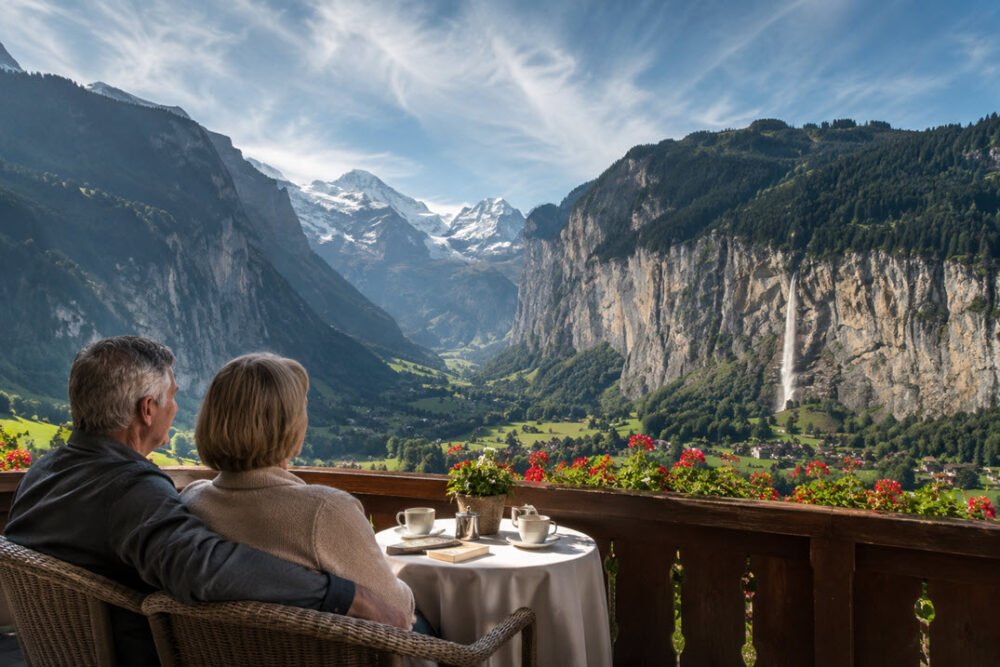
They’ve been sitting quietly on a hotel balcony with a cup of coffee, watching the first light touch the mountains. Or ending the day with a glass of wine as ferries glide across Lake Brienz or Lake Thun while the evening sun slowly disappears behind the peaks.
There is something deeply satisfying about having nowhere to rush to.
Doing nothing may sound unproductive, but in Switzerland, it often becomes one of the most memorable parts of the journey.
This is one of the reasons I encourage honeymoon couples to slow down and leave space for quiet moments together. I explore this further in my guide on How to Plan a Switzerland Honeymoon.
That doesn’t mean Wengen is the wrong choice.
Many excellent hotels provide luggage transfers from the station, making the journey almost effortless. For travellers who value beautiful scenery and a quieter atmosphere, Wengen can still be a wonderful option.
Mürren offers an entirely different experience. Perched high above the Lauterbrunnen Valley, it is wonderfully peaceful and completely car-free. Many travellers choose it because they enjoy the slower pace and spectacular mountain views. The trade-off is that reaching other parts of the Bernese Oberland generally takes a little longer.
Lauterbrunnen, on the other hand, is one of the region’s main transport hubs. Trains, cable cars and buses all connect here, making it an excellent base for exploring the surrounding mountains. The trade-off is that it is often busier, particularly during the peak summer months.
There is no perfect village.
Only the village that best matches how you want to experience Switzerland.
That, to me, is where thoughtful travel design makes all the difference.
Travel Designer Insight
The best hotel isn’t always the most luxurious. It’s the one that allows you to relax the moment you arrive.
Travelling Through Switzerland Is Part Of The Experience
One of the reasons Switzerland is such a rewarding destination is that travelling is never just about getting from one place to another.
The trains, lake cruises, mountain railways and cable cars are all part of the experience.
Rather than treating transport as something to get through as quickly as possible, I prefer to design journeys where travelling itself becomes one of the highlights.
A scenic train might take you through vineyards before climbing into the Alps. A leisurely cruise across Lake Brienz or Lake Thun offers a completely different perspective of the surrounding mountains. A cable car ride reveals landscapes that simply can’t be appreciated from the road.
Each mode of transport offers its own experience.
Just as importantly, they create a natural rhythm to the day.
Rather than rushing from attraction to attraction, there is time to sit back, enjoy the scenery and appreciate how dramatically the landscape changes as you move through Switzerland.
That rhythm extends beyond transport.
Some of the most memorable experiences aren’t necessarily the famous mountain peaks.
They may be spending a morning learning how traditional Swiss cheese is made in a small alpine village, enjoying a leisurely chocolate tasting with a local chocolatier, or lingering over lunch on a sunny terrace overlooking the mountains.
These experiences aren’t added simply to fill time.
They are carefully woven into the journey, creating natural pauses between mountain excursions, scenic railways and lake cruises.
The result is a holiday that feels balanced rather than busy.
Where the budget allows, I often recommend First Class travel on longer train journeys and lake cruises.
It isn’t about luxury for the sake of luxury.
It’s about giving yourself the space to slow down.
A quieter carriage, larger seats and panoramic windows allow you to simply watch Switzerland unfold outside.
The same applies to lake cruises. Spending an afternoon on the open deck, watching villages, vineyards and mountain scenery drift past, is one of those simple pleasures that many travellers remember long after they return home.
Another feature I frequently recommend is Switzerland’s luggage forwarding service.
Rather than carrying heavy suitcases onto every train, your luggage travels separately while you continue your journey with just a small overnight bag.
It is one of those thoughtful services that perfectly reflects how Switzerland is designed to make travelling easier.
For me, that is what makes Switzerland so special.
The destination is extraordinary.
But the journey between each destination can be just as memorable.
For a deeper look at Switzerland’s panoramic trains, rail passes and itinerary planning, read my guide on planning a luxury Switzerland train tour.
Travel Designer Insight
The journey isn’t what happens between destinations. In Switzerland, it is part of the destination.
More Than An Itinerary, Your Travel Companion
By the time you receive your Switzerland itinerary, what you see is only a small part of the work that has already taken place behind the scenes.
Long before a single page is written, hundreds of decisions have already been made.
Hotels have been researched and compared, not simply by star rating or price, but by their location, room layouts, views, accessibility, nearby restaurants, transport connections and the overall experience they offer. A room with a walk-in shower may be a better choice than a larger bathroom with a bathtub. A hotel a few minutes closer to the station may make every travel day noticeably easier. A mountain-facing balcony may encourage you to slow down and enjoy a quiet morning before heading out for the day.
Every accommodation is considered in the context of the journey as a whole.
Just as importantly, every recommendation is matched to the people travelling.
Some travellers enjoy spending an afternoon exploring on foot. Others value having a café just around the corner where they can sit and watch the world go by. Some prefer to be in the heart of a lively town, while others are happiest waking up to uninterrupted mountain views in a quieter village.
The right choice isn’t determined by the hotel.
It’s determined by the traveller.
The same thought process applies to every part of the journey.
Train connections are checked. Walking distances between platforms are considered. Mountain excursions are balanced against the weather. Lake cruises, local experiences and quieter moments are woven naturally into the itinerary so that the holiday feels balanced rather than rushed.
What you eventually receive is far more than a schedule of where to be each day.
It is an operational guide designed to travel with you.
It tells you what you need to know, when you need to know it. It removes unnecessary uncertainty, answers questions before they arise and allows you to travel independently with confidence.
Rather than wondering if you’re on the right platform, whether you have enough time to change trains, or how to reach your hotel after arriving, you can focus your attention on what really matters: enjoying Switzerland.
I don’t expect my clients to follow every minute exactly as written.
Quite the opposite.
The itinerary provides structure, but leaves room for spontaneity. Stay a little longer over lunch beside the lake. Spend another hour admiring the view from your hotel balcony. Swap tomorrow’s mountain excursion because the weather looks even better.
The planning gives you that flexibility.
In many ways, I don’t think of it as an itinerary at all.
I think of it as a compass.
One that quietly guides you through the journey, removes uncertainty and gives you the confidence to experience Switzerland at your own pace.
And if something unexpected happens, or you’re unsure about anything along the way, just send your travel designer a WhatsApp message. Assistance is never far away.
Travel Designer Insight
An itinerary tells you where to go. A thoughtfully designed travel companion gives you the confidence to enjoy the journey, knowing the important decisions have already been made.
Bringing Your Vision To Life
At the heart of it all, I don’t believe travel is about following someone else’s itinerary.
It’s about experiencing a destination in a way that feels right for you.
Some people dream of hiking mountain trails from sunrise to sunset.
Others imagine slow mornings overlooking a lake, leisurely train journeys through the Alps, discovering local cheese makers and chocolatiers, or simply spending an afternoon sitting on a balcony with nowhere else they need to be.
Neither way is better.
They’re simply different.
That is why every journey I design begins with understanding the people behind the holiday.
Their pace.
Their interests.
Their confidence.
Their concerns.
And ultimately, what they hope to feel when they return home.
Everything you’ve read in this guide, choosing the right base, selecting the right accommodation, balancing mountain excursions with the weather, weaving meaningful experiences into the journey, and creating a detailed travel companion, serves one purpose.
To remove uncertainty.
To build confidence.
And to allow you to experience Switzerland the way you always imagined.
Because I believe everyone deserves to travel well.
Regardless of age.
Regardless of experience.
Regardless of whether it’s your first visit to Switzerland or your fifth.
Travel should never feel intimidating.
It should feel exciting.
And with thoughtful planning, careful design and the right support, that vision can become a reality.
After all, my role isn’t simply to plan a holiday.
It’s to help you experience the journey you’ve always dreamed of, with the confidence to enjoy every moment along the way.
Travel Designer Insight
Everyone deserves to experience the world in a way that feels right for them. My role as a travel designer is to transform that vision into a journey you can enjoy with confidence.
If this article resonates with you, and you’re looking for a travel designer to help bring your Switzerland journey to life, I invite you to explore my approach to Switzerland Private Tours.
Every journey begins with a conversation.
About the Author
Best Teo is the Chief Travel Designer of Epic Travel Designer, a Singapore-based boutique travel company specialising in customised private journeys.
She is a Certified Switzerland Travel Expert and Swiss Travel System Excellence Expert, with firsthand experience travelling across Switzerland by rail, scenic trains, lake cruises and mountain transport.
Best designs customised Switzerland itineraries for couples, families and multi-generational travellers, with careful attention to routing, pacing, weather flexibility, hotel bases and travel logistics.
2 thoughts on “How to Plan a Switzerland Private Tour for Mature Travellers”
Comments are closed.