
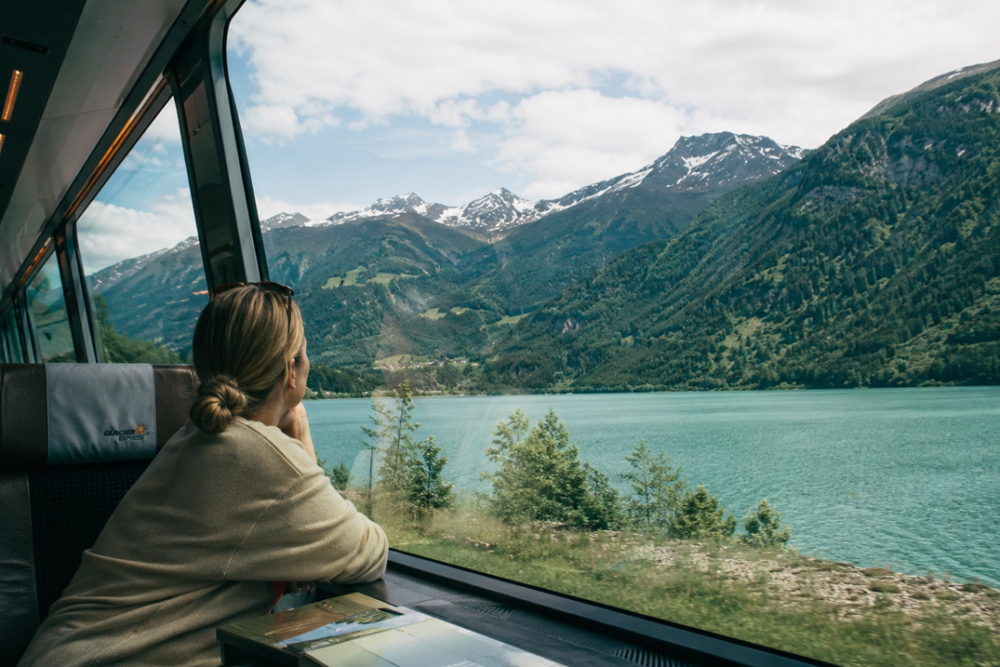
Luxury Is More Than a First Class Seat
Mention a luxury train journey in Switzerland and most people immediately think of the Glacier Express, the Bernina Express or travelling First Class.
While these are certainly part of the experience, I have come to realise that luxury in Switzerland is about something much deeper.
To me, luxury travel in Switzerland is rich in experiences. It is seeing the different faces of the country from panoramic trains, travelling comfortably at your own pace, and having enough time to slow down and appreciate the landscapes that unfold outside your window. It is never feeling rushed because your itinerary is trying to squeeze too much into too few days.
One of my favourite memories in Switzerland wasn’t even on a train.
It was a quiet hike from Zmutt village towards the Matterhorn. The trail passed through traditional alpine villages before opening onto the edge of the valley. As I continued walking, the Matterhorn slowly revealed itself in the distance. There were no tour groups, no queues and hardly another person around. Just the mountains, the sound of cowbells and the feeling that I could stop whenever I wanted to simply admire the view.
That moment changed the way I thought about luxury travel.
Luxury isn’t always about exclusivity or expensive hotels. Sometimes it is having the freedom to linger a little longer, to take the scenic route instead of the fastest one, and to experience Switzerland without constantly watching the clock.
This philosophy has shaped the way I design Switzerland journeys today.
Many travellers focus on ticking off famous trains or attractions. I prefer to think about how the entire journey feels. How one landscape transitions naturally into another. How each destination offers a different perspective of Switzerland. How the time between places becomes just as memorable as the places themselves.
Because in Switzerland, the journey is never simply about getting from A to B.
It is part of the experience itself.
Four Very Different Sides of Switzerland
Before my first trip to Switzerland, I thought I knew what to expect.
Snow-capped mountains, picturesque villages, scenic train rides and plenty of chocolate.
I wasn’t wrong.
I just didn’t realise how incredibly diverse the country was.
Over the course of my journey, I discovered that Switzerland isn’t one destination. It is a collection of remarkably different landscapes, cultures and experiences, each with its own unique character. That diversity is one of the reasons I believe Switzerland is one of the world’s greatest countries to explore by rail.
If you’re still deciding where to visit, my Switzerland Travel Planner explains the different regions and how to choose the ones that best match your travel style.
Classic Switzerland
When most people picture Switzerland, this is what comes to mind.
Wooden chalets adorned with colourful flower boxes. Emerald valleys dotted with grazing cows. Waterfalls cascading down towering cliffs. Peaceful villages where church bells echo through the mountains.
It is timeless, picturesque and every bit as beautiful as you’ve imagined.
This is the Switzerland that has captured travellers’ hearts for generations.
Switzerland’s Wine Country
Then there is a side of Switzerland that surprises many first-time visitors.
Rolling vineyards stretch along the shores of Lake Geneva, historic towns invite leisurely afternoon strolls, and some of the country’s finest wines are produced on sun-drenched terraces overlooking the lake.
The mountains may still be visible in the distance, but the atmosphere feels softer, slower and quietly elegant.
It is a side of Switzerland that many visitors never realise exists.
Mediterranean Switzerland
Perhaps the biggest surprise of all.
Palm trees line the lakeside promenades. Italian is widely spoken. Outdoor cafés spill onto charming piazzas, and the pace of life feels unmistakably Mediterranean.
If someone handed you a photograph without telling you where it was taken, Switzerland probably wouldn’t be your first guess.
Yet somehow, it all works beautifully.
The High Alps
And then there are the mountains.
Towering peaks, ancient glaciers, deep valleys and panoramic rail journeys through some of Europe’s most spectacular scenery.
This is Switzerland at its most dramatic, where every turn of the journey reminds you just how extraordinary nature can be.
It is impossible not to feel humbled here.
What fascinates me most isn’t that these places exist.
It’s that they all exist within one relatively small country.
On the same day, you can leave towering peaks and glaciers behind, only to arrive a few hours later beneath palm trees on Switzerland’s sunny southern side.
On another day, you might find yourself wandering through a fairytale alpine village before enjoying an evening overlooking vineyard-covered hills beside Lake Geneva.
Every region has its own character. Every journey tells a different story.
This is why I often describe Switzerland as a country with four very different sides.
The trains simply connect them together.
Planning Your Switzerland Train Journey
Planning a train journey through Switzerland is surprisingly different from planning a rail holiday in most other countries.
Many first-time visitors begin by asking questions such as:
Which rail pass should I buy?
Should I travel First Class or Second Class?
Do I need seat reservations?
These are all important questions.
But they’re not the first questions I ask when designing a journey.
Instead, I start by understanding the traveller.
What kind of experiences are they hoping to have?
Do they enjoy leisurely walks through alpine villages or challenging mountain hikes?
Would they rather spend an afternoon cruising across a lake or exploring a vineyard?
Are they travelling for a honeymoon, celebrating a milestone, or simply fulfilling a lifelong dream of visiting Switzerland?
The answers to these questions shape every decision that follows.
How Many Days Do You Really Need?
One of the first decisions when designing a Switzerland train journey is deciding how much time to allow.
Could you visit Switzerland in five or six days?
Absolutely.
If you’re visiting Switzerland for the first time, my 12-Day Switzerland Itinerary is a good example of how to experience the country’s highlights at a comfortable pace without feeling rushed.
Could you spend three weeks exploring the country and still leave wanting to return?
Without question.
In my experience, Switzerland is one of those rare destinations that rewards travellers who slow down. For travellers with more time, my 18-Day Switzerland Luxury Rail Tour shows how a slower pace allows you to experience even more of the country’s incredible diversity.
Having additional time doesn’t simply allow you to visit more places. It gives you the flexibility to experience the country on its own terms. To swap mountain excursions when the weather changes. To spend an extra afternoon in a village you unexpectedly fall in love with. To enjoy the journey instead of constantly thinking about the next train.
The real question isn’t how many days you have.
It’s how you want your journey to feel.
Choosing the Right Rail Pass
Choosing the right rail pass is almost an art in itself.
Most first-time visitors have heard of the Swiss Travel Pass, and it is certainly one of the most popular options. However, that doesn’t automatically make it the best choice for every traveller.
Switzerland offers a surprisingly wide range of rail passes. Besides the Swiss Travel Pass, there are regional passes such as the Bernese Oberland Pass and Tell Pass, the Swiss Half Fare Card, Saver Day Passes and several other ticket combinations.
To accurately determine the most suitable rail pass, you first need to know the itinerary. Only then can you evaluate which option offers the best balance between value, convenience and flexibility.
In other words, the itinerary should determine the rail pass, not the other way around.
For some travellers, the Swiss Travel Pass is the ideal choice because of its simplicity and convenience. For others, combining regional passes or alternative ticket options can provide significantly better value.
There are even online calculators that compare the different rail pass options. As part of my travel design process, this is something I evaluate for every client to ensure the chosen pass complements the journey they are taking.
Is First Class Worth It?
Another question I’m often asked is whether First Class is worth the additional cost.
My answer is always the same.
It depends.
Some travellers are perfectly happy travelling in Second Class. Others value a quieter and more comfortable experience, especially on longer train journeys.
Imagine arriving at a busy station during the peak travel season with your luggage.
Would you rather join the crowd waiting to board the Second Class carriage, hoping to find seats together and enough luggage space?
Or would you prefer to board the First Class carriage at a more relaxed pace, store your luggage comfortably and settle in before the journey begins?
Neither choice is right or wrong.
It simply depends on the type of travel experience you want.
Interestingly, not every First Class upgrade offers the same value.
For scenic lake cruises, I almost always feel the upgrade is worthwhile. First Class passengers typically enjoy access to quieter seating areas or open-air upper decks, allowing you to appreciate the scenery away from the larger crowds.
On the other hand, for mountain cogwheel railways, funiculars and cable cars, there is often little or no meaningful difference between First and Second Class.
Once again, the value of upgrading depends entirely on your itinerary and whether the additional comfort enhances the overall journey.
Do You Need Seat Reservations?
Another common misunderstanding is that a rail pass automatically guarantees you a seat on every train.
In Switzerland, that isn’t always the case.
Some panoramic trains require reservations even if your rail pass covers the journey, while many regular services allow you to simply board and travel without one.
Understanding the difference before you arrive can help avoid unnecessary stress, especially during the busy travel season.
Why Flexibility Matters
One lesson I learnt very quickly in Switzerland is that the mountains have their own timetable.
In many parts of the country, particularly the High Alps and classic Switzerland, the weather can change remarkably quickly. A mountain hidden by clouds in the morning may reveal perfect views later in the day, while brilliant sunshine can disappear just as fast.
This is why I rarely think of a Switzerland itinerary as something completely fixed.
Instead, I believe the best journeys are designed with enough flexibility to respond to the weather.
Mountain excursions, scenic hikes and panoramic viewpoints should be planned around the conditions, not simply around the calendar.
Sometimes the best decision isn’t following the itinerary exactly as planned.
It’s recognising when changing the plan will create a much better experience.
Experiencing the Four Sides of Switzerland
If someone asked me how I would design a first-time Switzerland train journey, I would usually recommend allowing 14 to 16 days.
If you’re looking for inspiration, you can also explore my 14-Day Epic Grand Train Tour, which brings together some of Switzerland’s most spectacular scenic rail journeys and mountain experiences.
Not because there is a magic number.
But because it gives you enough time to experience what I believe makes Switzerland one of the world’s greatest rail destinations, its incredible diversity.
Rather than focusing on a single region, I prefer designing journeys that allow travellers to experience the four very different sides of Switzerland.
You might find yourself wandering through fairytale alpine villages surrounded by waterfalls and flower-filled meadows.
On another day, you could be standing before towering glaciers and majestic mountain peaks that make you feel wonderfully small.
Perhaps you’ll be sipping coffee beneath palm trees beside a sparkling lake, wondering how Switzerland can feel so unmistakably Mediterranean.
Or you may be strolling through vineyard-covered hills overlooking Lake Geneva, where the pace slows and the scenery takes on an entirely different character.
Every region reveals a different side of Switzerland, each with its own landscapes, culture and rhythm.
Connecting these experiences are some of Switzerland’s most spectacular panoramic train journeys, including the world-famous Bernina Express.
For many travellers, riding the Bernina Express is a lifelong dream, and it deserves its reputation as one of the world’s most scenic rail journeys.
The good news is that you don’t have to ride it in both directions, giving you more time to experience the destinations themselves instead of retracing your journey.
With thoughtful itinerary planning, it can be seamlessly incorporated into your journey, allowing you to enjoy the spectacular experience without unnecessary backtracking or retracing your route.
When every part of the journey has been thoughtfully connected, the trains become more than individual attractions. They become part of one seamless travel experience.
Just as importantly, I don’t believe a memorable Switzerland holiday should be spent entirely on trains.
The journey should leave enough time to step off and truly experience the places you have travelled so far to see.
That might mean spending a full day exploring the mountains, enjoying a leisurely walk or scenic hike in the Bernese Oberland, wandering through a quiet alpine village, taking a lake cruise, or admiring spectacular views from Mount Pilatus or the Stoos Ridge.
These moments are every bit as memorable as the panoramic rail journeys themselves.
The beauty of a well-designed Switzerland itinerary isn’t simply the places you visit.
It’s how naturally everything comes together.
That is the Switzerland I strive to design for every client.
5 Common Mistakes First-Time Switzerland Train Travellers Make
Even with one of the world’s best rail networks, Switzerland isn’t always as straightforward as it first appears.
Over the years, I’ve noticed that many first-time travellers make the same mistakes. Fortunately, most are easy to avoid with thoughtful planning.
If you’re visiting Switzerland for the first time, you may also enjoy my guide on the 5 common mistakes first-time Switzerland travellers make, where I cover practical planning tips beyond scenic train journeys.
1. Trying to See Too Much
Switzerland may look small on a map, but every region offers a completely different experience.
Trying to squeeze every famous destination into one trip often means constantly changing hotels, spending more time packing than enjoying, and missing the very moments that make Switzerland so memorable.
A well-designed itinerary isn’t about seeing everything. It’s about seeing the right things, at the right pace.
2. Choosing a Rail Pass Before Planning the Journey
One of the most common mistakes is deciding on a rail pass first, then trying to build an itinerary around it.
I believe the opposite approach works far better.
Design the journey first.
Then choose the rail pass that best supports it.
Sometimes that’s a Swiss Travel Pass. Other times it may be a Bernese Oberland Pass, Half Fare Card or Saver Day Pass. The best choice always depends on the journey you want to experience.
3. Planning Every Mountain Excursion Months in Advance
The mountains have their own timetable.
Blue skies can become cloud-covered within hours, while an ordinary forecast can turn into a spectacular mountain day.
Whenever possible, I prefer building enough flexibility into an itinerary so that mountain excursions can be swapped around according to the weather. Waiting just one day can completely transform the experience.
4. Treating the Train as the Destination
This may sound surprising in an article about Switzerland train journeys.
The trains are undoubtedly one of the highlights of visiting Switzerland, but they shouldn’t become the entire holiday.
The most memorable moments often happen after you step off the train: a quiet alpine village, an easy lakeside walk, lunch with a mountain view, or simply sitting on a bench watching the scenery unfold.
The trains connect these experiences. They are not meant to replace them.
5. Assuming Panoramic Trains Work Like Regular Trains
One of the most common misconceptions is thinking that Switzerland’s famous panoramic trains operate just like any other train.
They don’t.
While your rail pass or ticket may cover the journey, iconic trains such as the Bernina Express require a separate seat reservation. During the peak travel season, these seats can sell out weeks or even months in advance.
I’ve also helped clients secure Bernina Express reservations after discovering their preferred departure had already sold out. It’s a small detail, but one that can have a significant impact on the overall journey.
Fortunately, with a little forward planning, it’s an easy mistake to avoid. If you’re wondering what happens when the Bernina Express is already sold out, I’ve shared a real client story and the options that may still be available in my article, Bernina Express Sold Out? Here’s What You Can Do.
Why Trust My Recommendations?
Switzerland has always fascinated me, not just because of its spectacular scenery, but because of how effortlessly everything works together.
The trains, mountain railways, cable cars, lake cruises and scenic walking trails aren’t isolated attractions. They form a transport network that allows travellers to experience the country in a way few destinations can offer. Understanding how all these pieces connect became just as enjoyable for me as the journey itself.
To deepen my knowledge, I became a Certified Switzerland Travel Expert and later completed the Swiss Travel System Excellence Expert Diploma. I also spent a month travelling extensively across Switzerland, experiencing its panoramic trains, mountain excursions, villages and scenic routes firsthand.
But qualifications are only part of the story.
If you’re considering working with a professional, here’s what I believe you should look for when choosing a Switzerland travel planner.
As a travel designer, every journey I create begins with people, not places.
Before recommending a route, I think about who is travelling. Their pace, interests, mobility, travel style and priorities all influence the final itinerary. A honeymoon couple will experience Switzerland differently from a retired couple, a family with young children or a group of close friends.
That’s why I don’t believe there is a single “best” Switzerland itinerary.
There is only the one that is best for you.
My goal has never been to help clients see the most places.
It’s to design a journey that feels seamless, unhurried and deeply memorable, long after they’ve returned home.
Conclusion
Switzerland is often described as one of the world’s most beautiful countries.
After spending time exploring its mountains, villages and scenic railways, I believe it’s much more than that.
It’s a country best experienced slowly, with enough time to discover that every region has its own unique character and every journey tells a different story.
Whether your dream is riding the Bernina Express, standing before towering glaciers, wandering through quiet alpine villages or simply relaxing beside a lake with a cup of coffee, the memories you’ll treasure most are often the moments that couldn’t be captured in a checklist.
That’s the beauty of Switzerland.
And that’s the kind of journey I strive to design for every client.
Ready to Start Planning?
Planning a Switzerland train journey can feel overwhelming, but it doesn’t have to be.
If you’d like a journey that’s thoughtfully designed around your interests, pace and travel style, I’d love to help.
About the Author
Best Teo is the Chief Travel Designer of Epic Travel Designer, a Singapore-based boutique travel company specialising in customised private journeys.
She is a Certified Switzerland Travel Expert and Swiss Travel System Excellence Expert, with firsthand experience travelling across Switzerland by rail, scenic trains, lake cruises and mountain transport.
Best designs customised Switzerland itineraries for couples, families and multi-generational travellers, with careful attention to routing, pacing, weather flexibility, hotel bases and travel logistics.
8 thoughts on “How to Plan a Luxury Switzerland Train Tour”
Comments are closed.