
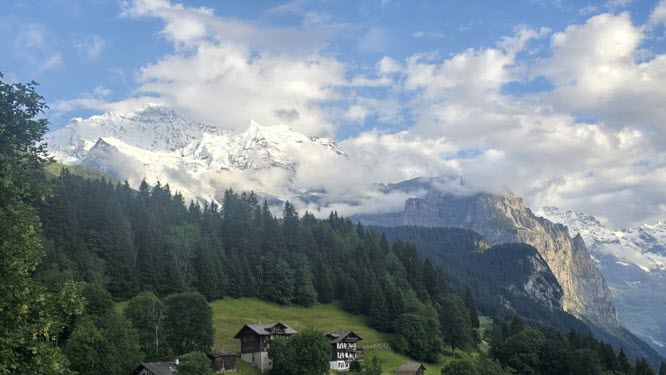
The picture above shows the view from my hotel in Wengen one evening. After the day-trippers had returned to the valley, it felt as though I had the whole mountains to myself.
If you’re visiting Switzerland for the first time and staying four or five nights in the Jungfrau region, I would usually recommend Wengen over Lauterbrunnen. During my own stay in Wengen, I found myself looking forward to returning each evening. As the last trains brought day-trippers back down to the valley, the village became wonderfully quiet. It felt as though I had the whole mountains to myself.
Clients often assume that Lauterbrunnen looks more practical because it sits in the valley and appears closer to everything on the map.
That assumption is understandable. Lauterbrunnen is the name most travellers recognise first. It has the dramatic cliffs, the waterfalls, the train station, and the valley photos that have travelled far beyond Switzerland. If you are planning from a distance, it feels like the obvious place to base yourself.
But once I start designing the actual itinerary, with check-in timing, luggage, day trips, dinner plans, weather windows, and how people feel after several days of travelling, I usually lean towards Wengen for first-time visitors.
Not always. There are travellers for whom Lauterbrunnen makes sense. But for most guests staying four or five nights in the Jungfrau region, I would rather they stay in Wengen and visit Lauterbrunnen properly, instead of sleeping in the busiest part of the valley.
The difference is not only geographical. It changes the feeling of the trip.
Lauterbrunnen Looks More Convenient Than It Feels
On paper, Lauterbrunnen has a strong argument. It is the valley station. Trains connect from Interlaken Ost. From there, you can go up towards Wengen and Kleine Scheidegg, across towards Mürren, or continue into the valley for waterfall walks.
For a day visitor, that convenience is useful. For someone staying overnight, it can feel quite different.
Lauterbrunnen is not just a village. It is also a transit point. People arrive with backpacks, tour groups pause for photos, buses move through, and the main paths can become crowded during the day. The valley is beautiful, but it is also where many people funnel through because the geography naturally directs them there.
I have seen travellers choose Lauterbrunnen thinking they will have a peaceful alpine base, then feel slightly overwhelmed once they realise how busy the central area becomes in peak hours. The waterfalls are still magnificent. The cliffs are still impressive. But the atmosphere can be more functional than restful.
Choosing a base solely for apparent convenience is one of the most common Switzerland planning mistakes first-time travellers make.
This matters because accommodation is not only about where you sleep. It is where you recover between excursions. After a long day to Jungfraujoch or a mountain walk at Männlichen, most travellers do not want to return to the energy of a transport corridor.
They want the day to soften.
Why Wengen Feels Better as a Base
Wengen sits above Lauterbrunnen on a mountain terrace, reached by a short cogwheel train ride from the valley. It is not difficult to access. It simply asks you to go one layer higher.
That small shift makes a large difference.
The village is car-free, so the soundscape changes almost immediately. You hear footsteps, hotel carts, cowbells in season, the train arriving and leaving, and very little road noise. For many of my clients, this is the moment their Swiss holiday begins to feel like what they had imagined, not because it is polished, but because it gives them space to settle.
The views are also different. Lauterbrunnen sits on the valley floor, enclosed by steep cliffs. It is dramatic, but parts of the village can feel shaded depending on the time of day and season. Wengen, by contrast, gives you a higher, more open perspective across the valley and towards the surrounding peaks.
This is why I often recommend clients stay in Wengen if they value experience over pure convenience. You wake up to mountain views. You return in the evening to softer light over the slopes. After the day visitors have gone, the village becomes quieter, and a simple walk after dinner can feel more rewarding than another planned excursion.
It is not about doing more. It is about placing yourself somewhere that makes the quieter hours count.
The Routing Is Easier Than Many People Expect
The hesitation with Wengen is usually luggage and access. Because it is car-free, travellers worry it will be complicated. In practice, for a well-planned Swiss rail itinerary, it is very manageable.
You arrive by train into Lauterbrunnen, then connect to the cogwheel train up to Wengen. The ride is short, around 12 minutes, and the connection is part of the regional rail system. If your hotel is sensibly chosen near the station or offers luggage assistance, the arrival is not difficult.
This is where planning judgment matters. I would not place a family with several large suitcases in a hotel far uphill unless they understand the walk. I would not schedule a late arrival after a long international flight and expect them to manage everything casually. But with the right timing and hotel selection, Wengen works very well.
It also sits beautifully for mountain excursions. From Wengen, you can go up to Männlichen, continue towards Kleine Scheidegg, or connect onward for Jungfraujoch. These are not minor details. They affect how early you need to start, how much train time you absorb, and how the day feels.
A common mistake is choosing the base only by looking at the first arrival. The better question is how the next four days will flow. This is one of the central decisions a Switzerland travel planner considers: not simply which village is easiest to reach, but which base makes the whole stay work better.
If Wengen saves emotional energy each evening and gives you easier access to the mountain experiences you care about most, the extra cogwheel connection is not a disadvantage. It is part of the design.
I Would Still Visit Lauterbrunnen, Just Not Always Sleep There
Recommending Wengen does not mean skipping Lauterbrunnen. That would be a mistake.
The valley has its own character, and the waterfall walks are worth making time for. Staubbach Falls gives the village its famous profile, while Trümmelbach Falls offers a very different encounter with water and rock. If the weather is kind and you have enough time, walking through the valley allows you to understand why this landscape has such a strong hold on travellers.
I would simply separate the visit from the overnight decision.
For example, a well-paced day might begin in Wengen, descend to Lauterbrunnen after breakfast, walk part of the valley, visit the waterfalls, then continue towards Stechelberg or return when you have had enough. You experience the valley when it serves the itinerary, instead of being surrounded by its daytime movement from morning to evening.
This is especially important for first-time visitors trying to balance sightseeing with rest. Switzerland can tempt people into over-scheduling because the train system is so efficient. The danger is that every day becomes a sequence of connections, viewpoints, and rushed meals.
Staying in Wengen helps slow that down. You are already in the mountains. You do not need to chase the feeling of being there.
Who Should Choose Lauterbrunnen Instead
There are still situations where I would choose Lauterbrunnen.
If someone has only one night in the region, wants the simplest possible transfer, and plans to move on early the next morning, Lauterbrunnen can be practical. If a traveller is focused mainly on the valley waterfalls and does not care much about a mountain village atmosphere, staying below may also be reasonable.
It can also suit those who want slightly broader transport options at their doorstep, especially if they are splitting time between the Mürren side and the Wengen, Kleine Scheidegg side. For some itineraries, reducing one connection matters more than improving the evening ambience.
But I would be careful with this choice in high season. A hotel that looks charming in photos may still place you close to busy foot traffic, roads, or heavily used paths. If the purpose of the stay is to feel rested, the setting around the hotel becomes just as important as the hotel itself.
The question is not whether Lauterbrunnen is beautiful. It is. The better question is whether it gives you the version of the Jungfrau region you are hoping to carry home with you.
For many first-time visitors, Wengen does that more naturally. That quieter rhythm is one reason Wengen can work particularly well for couples. I discuss this further in my guide on how to plan a Switzerland honeymoon.
See how Wengen fits into my suggested 12-day Switzerland itinerary for first-time visitors.
Conclusion
When comparing Wengen vs Lauterbrunnen, I do not see it as a contest between right and wrong. I see it as a question of travel behaviour.
Lauterbrunnen is impressive, accessible, and absolutely worth visiting. But it can feel busy because it serves as both destination and transit point. Wengen asks for one short climb by train, then rewards you with quieter evenings, open mountain views, and a stronger sense of being based in the Alps rather than passing through them.
If you are staying only briefly, Lauterbrunnen may be enough. If you have four or five nights and want your base to contribute to the holiday, I would usually encourage you to stay in Wengen.
It is a small planning decision with a noticeable effect on how the whole region feels.
Choosing where to stay isn’t just about geography. It’s one of dozens of small decisions that shape how a Switzerland holiday feels. From selecting the right mountain base to pacing the route, handling luggage, choosing the right rail passes, and deciding which excursions are worth your time, these decisions may seem small on their own. Together, they can make the difference between a trip that feels rushed and one that feels effortless.
Choosing between Wengen and Lauterbrunnen is only one part of creating the right Switzerland journey. Explore my custom Switzerland private tours from Singapore, designed around your pace, interests, mobility and preferred travel experience.
About the Author
Best Teo is the Chief Travel Designer of Epic Travel Designer, a Singapore-based boutique travel company specialising in customised private journeys.
She is a Certified Switzerland Travel Expert and Swiss Travel System Excellence Expert, with firsthand experience travelling across Switzerland by rail, scenic trains, lake cruises and mountain transport.
Best designs customised Switzerland itineraries for couples, families and multi-generational travellers, with careful attention to routing, pacing, weather flexibility, hotel bases and travel logistics.
4 thoughts on “Why I Recommend Wengen Over Lauterbrunnen for Most First-Time Switzerland Visitors”
Comments are closed.